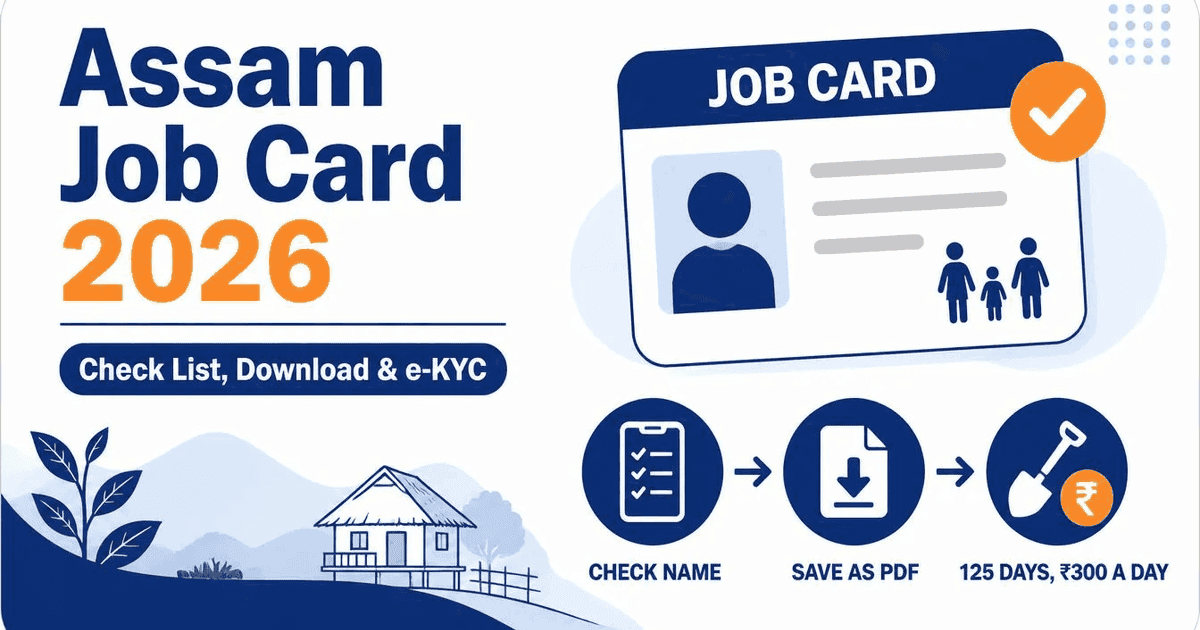
Your Assam job card is the card that lets your household ask the Gram Panchayat for paid manual work, and on 1 July 2026 the rules behind it changed. MGNREGA, the 2005 law the card was issued under, was repealed that day. It was replaced by the Viksit Bharat – Guarantee for Rozgar and Ajeevika Mission (Gramin) Act, 2025, shortened to VB-G RAM G. The work guarantee went up from 100 to 125 days a year, and the daily wage in Assam went up from ₹256 to ₹300.
If you searched for MGNREGA Assam or NREGA Assam, this is the same card under its new law. This guide is for rural households in Assam who already hold a job card or want one. It covers how to find your name in the job card list, how to save a copy of your card, whether your old card still works, and how to apply for a new one. If you are looking for the Employment Exchange registration card (the X-10 card) that government job forms ask for, that is a different card: see how to register for the Employment Exchange in Assam.
Everything here is checked against the Ministry of Rural Development's notices of 11 May 2026 and the live NREGA portal as of 30 September 2026.
What changed for the Assam job card on 1 July 2026
The Centre notified the new Act on 11 May 2026 and brought it into force across every rural area of India on 1 July 2026. Nothing about how you ask for work at the panchayat has been thrown out. The main numbers moved up.
| MGNREGA (up to 30 June 2026) | VB-G RAM G (from 1 July 2026) | |
|---|---|---|
| Days of work guaranteed per household | 100 a year | 125 a financial year |
| Daily wage in Assam | ₹256 | ₹300 |
| Name of the card | Job card | Gramin Rozgar Guarantee Card |
| Work given within | 15 days of asking | 15 days of asking |
| Wage paid | To your bank or post office account | To your bank or post office account, weekly or within 15 days of the muster roll closing |
| Cost shared by Centre and Assam | Centre paid the full wage bill | 90:10 (the North Eastern states' ratio) |
Two new rules are worth knowing. Attendance at the worksite is now taken by face authentication, with a fallback when the network or the phone fails. And the state can declare a pause of up to 60 days a year in peak sowing and harvest season, when no scheme work runs. Your panchayat will know Assam's dates.
Is your old MGNREGA job card in Assam still valid?
Yes, if its e-KYC is done. The ministry's rule is that existing MGNREGA job cards with completed e-KYC stay valid until the new Gramin Rozgar Guarantee Cards are issued. You do not need to apply again. Keep using the job card number you have.
If your e-KYC is still pending, you still cannot be refused work. The ministry said so when it notified the Act in May, and repeated it at the end of August: e-KYC checks the database, it is not a condition for asking for work. Get it done anyway, because it keeps your name safe when the list is cleaned. The panchayat's Gram Rozgar Sahayak does it with a face-authentication app and your Aadhaar. Take your Aadhaar card and the phone number linked to it.
No date has been announced for the new cards. If someone asks you for money to "convert" your old job card, that is not an official step.
How to check your name in the Assam job card list
The job card list lives on the Ministry of Rural Development's NREGA portal. One oddity: in September 2026 the reports pages still carry the old MGNREGA name. That is the right site. Pages that promise a "job card list PDF" on other domains are copies, and many are out of date. When in doubt, check our list of official websites.
- Open nrega.dord.gov.in.
- In the menu, go to Reports and choose State. A list of states opens.
- Tap ASSAM.
- On the Assam page, find the Gram Panchayat reports and tap Job Cards.
- Pick the financial year (2026-2027 for the current year), then your district, block and panchayat, and tap Proceed.
- Open the Job card/Employment Register. You will see every job card in the panchayat, with the head of household's name next to each number.
- Find your name and tap your job card number to open the card.
The site is slow on mobile data, and the menus are small on a phone screen. If a page will not load, go back one step and try again, or switch your browser to desktop view.
Assam job card download: save a copy on your phone
There is no separate "download" button. The card page you opened in the last step is the job card, and you save it from your browser.
- On an Android phone: open the browser menu, tap Share then Print, and choose Save as PDF.
- On a computer: press Ctrl + P and choose Save as PDF.
A screenshot works too. If you have several screenshots, join them into one file with the image to PDF tool. It runs on your phone, so the card is never uploaded anywhere.
The card shows your job card number (in Assam it starts with AS), the head of household, each adult member with age and gender, and the days of work each person has done. If a name, age or photo is wrong, the Gram Panchayat can correct it. The website cannot.
Who can get an Assam job card
Any rural household whose adult members are willing to do unskilled manual work. Adult means 18 or older; if you are not sure a family member has turned 18, the age calculator works it out from a date of birth. There is no income limit and no education requirement. The card is issued to the household, so one card covers every adult in the family.
How to apply for a new Gramin Rozgar Guarantee Card
If your household has never had a job card, the steps are simple:
- Go to your Gram Panchayat office. Any adult in the household can apply.
- Give the name, age and address of each adult member who wants work. You can apply in writing or by saying it to the panchayat staff, who fill the form.
- Take Aadhaar for each member and your bank or post office passbook, so wages can be paid into the account and the e-KYC can be done.
- The panchayat checks the details and registers the household. Ask for a receipt when you apply.
There is no fee at any step.
How to ask for work with your job card
Having a card does not start the work. You have to ask. Apply to the Gram Panchayat in person, in writing on Form 6, or through a digital platform, and ask for a dated receipt. The date on it matters.
- Work must be given within 15 days of that date, and as far as possible within 5 km of your village. If the site is further away but inside your block, you get 10% more wage for travel and living costs.
- If no work comes within 15 days, the state has to pay an unemployment allowance: at least a quarter of the wage for the first 30 days (at least ₹75 a day at ₹300), and at least half after that (at least ₹150 a day).
- If wages are late by more than 15 days after the muster roll closes, you are owed compensation of 0.05% of the unpaid wages for each day of delay.
Every worksite has to have drinking water, shade for rest and for children, and a first aid box, and a "Janata Board" showing what the work is and what it costs. Contractors and labour-replacing machines are not allowed.
If your name is missing or your wages have not come
- Name missing from the list: check that you picked the right financial year, block and panchayat. Then ask the Gram Panchayat whether the card was deleted during a clean-up. Genuine workers have been deleted by mistake before. The panchayat can restore or re-register you.
- Wages not paid: first confirm your bank account is linked to Aadhaar and active. If it is, complain to the Programme Officer at the block (an officer of Block Development Officer rank). The District Collector is the District Programme Coordinator above that. The NREGA portal also has a Public Grievances link on its home page.
Looking for a salaried job too?
The job card guarantees daily-wage work, not a salaried post. If you or someone in your family has passed Class 8, 10 or 12, Assam's Grade III and Grade IV recruitment is worth a look. Read the ADRE guide, browse the latest government jobs in Assam, and use the eligibility checker to see which ones fit your age and qualification.